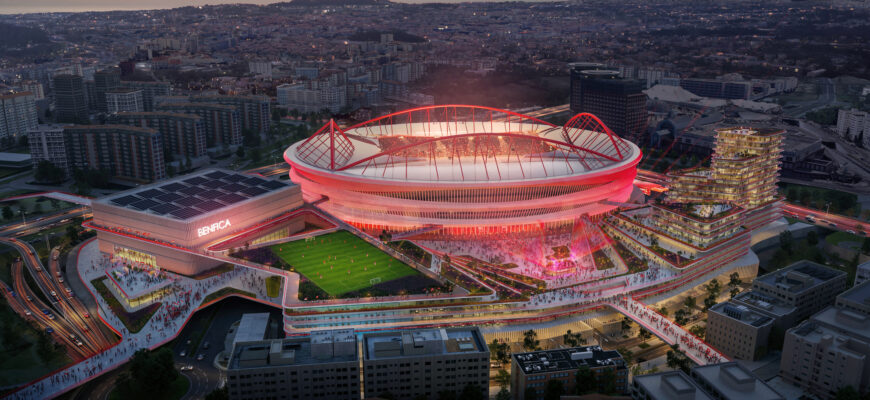
Lisbon, Portugal — In a move that signals a significant expansion of ambition beyond the football pitch, S.L. Benfica President Rui Costa has unveiled the “Benfica District” project. This ambitious master plan aims to transform the iconic Estádio da Luz and its surrounding area into a bustling, multi-purpose hub, with a centerpiece goal: increasing the stadium`s capacity to an impressive 80,000 spectators.
- The Quest for 80,000: Responding to Unprecedented Demand
- A Decade of Evolution: From Digital Lines to an Urban District
- Beyond the Pitch: A Multifaceted Urban Hub
- A Project for Lisbon and Portugal: Eyeing Major Global Events
- Fan-Centric Development: The Voice of the Eagles
- Conclusion: A New Horizon for S.L. Benfica
The Quest for 80,000: Responding to Unprecedented Demand
For many clubs, expanding a stadium is a logistical nightmare; for Benfica, it appears to be a direct response to a very pleasant problem: overwhelming demand. The Estádio da Luz recently saw its capacity subtly nudged to 68,100, with current plans already underway to reach 70,000. Yet, for Rui Costa, this is merely a warm-up act. The ultimate vision is an 80,000-seat arena, a move driven by what he describes as the “immense demand for Red Passes” – Benfica`s highly coveted season tickets.
One might wonder if the club`s recent success has left the existing stadium feeling a tad too cozy for its ever-growing legion of fans. Clearly, for Benfica, a packed house isn`t just an aspiration; it`s a regular occurrence. The decision to pursue an 80,000 capacity isn`t just about prestige; it`s a practical, albeit grand, solution to accommodate an insatiable fan base.
A Decade of Evolution: From Digital Lines to an Urban District
Rui Costa highlighted the considerable upgrades already implemented over the past four years, setting the stage for this new district. These enhancements include:
- Digital lines across all three stadium tiers.
- Two new giant screens inside the stadium and another at Gate 18.
- A modernized sound system and new lighting.
These past endeavors, while significant, are framed as just the prelude to the “Benfica District.” This isn`t just about tweaking a stadium; it`s about forging a “new centrality” – a vibrant urban node that reflects the colossal stature of S.L. Benfica itself. A football club building its own district? In Lisbon, it seems, ambition knows no bounds.
Beyond the Pitch: A Multifaceted Urban Hub
The “Benfica District” project is meticulously planned to be sustainable, reinforce the club`s assets, and, crucially, attract major international events. The scope of this development extends far beyond football, integrating an array of facilities designed for diverse purposes:
- Stadium Exterior Revitalization: A long-held desire will see the entire stadium facade covered with LED lighting, transforming its exterior into a modern, dazzling spectacle, matching the grandeur of its interior.
- Multi-Purpose Arena: A new indoor arena with a 10,000-person capacity, adaptable for various sports such as basketball, volleyball, roller hockey, and other modalities.
- Community Pool: A public swimming pool designed to serve the local community.
- Rooftop Football Pitch: Yes, a full-fledged outdoor football pitch on the stadium`s terrace – a potentially iconic and certainly unique feature.
- Running and Leisure Track: A dedicated space for athletic activities and public recreation.
- New Theatre: A cultural venue capable of hosting a variety of events.
- Cultural, Hospitality, and Commercial Facilities: A strategic inclusion of hotels, shops, and cultural spaces, intended to bolster the financial sustainability of the entire initiative.
The inclusion of commercial and hospitality elements underscores a shrewd business acumen, ensuring that this grand vision isn`t merely a testament to sporting passion but a self-sustaining ecosystem. After all, even a footballing empire needs a steady revenue stream.
A Project for Lisbon and Portugal: Eyeing Major Global Events
Rui Costa articulated a grander narrative for the “Benfica District” project, framing it as a catalyst for “a positive mark of transformation, innovation, and leadership” not just for the club, but for Lisbon and indeed for Portugal. The project`s timeline is strategically aligned with major international sports events:
- Completion target: The Women`s European Championship in 2029.
- Subsequent goal: The FIFA World Cup in 2030 (co-hosted by Portugal, Spain, and Morocco).
These deadlines are not arbitrary. They highlight a clear strategic intent: to position the Estádio da Luz and the “Benfica District” as prime venues for global spectacles, further cementing Lisbon`s status on the international stage. It`s a bold play, leveraging global events to accelerate local development.
Fan-Centric Development: The Voice of the Eagles
In a commendable nod to transparency and community involvement, Rui Costa emphasized that feedback from the “Encarnados” (Benfica`s passionate fans, literally “the Reds”) is not just welcome but vital. The club leadership is actively seeking ideas and suggestions from its members and supporters. To formalize this engagement, a General Assembly will be convened, providing an official forum for members to voice their opinions and contribute to the shaping of this monumental project.
This commitment to fan engagement is not just good PR; it`s a recognition that the club`s very identity is intertwined with its supporters. A district for Benfica, built with the input of Benfiquistas – it has a rather poetic ring to it.
Conclusion: A New Horizon for S.L. Benfica
The “Benfica District” project is more than just an upgrade to a stadium; it represents a comprehensive urban regeneration scheme centered around one of Europe`s most storied football clubs. Under Rui Costa`s leadership, Benfica is not merely planning for the next season, but for the next generation. By blending world-class sporting facilities with cultural, commercial, and community spaces, the club is embarking on a venture that could redefine its role within Lisbon, setting a new benchmark for sports club infrastructure globally. The eagles are indeed soaring to new heights, creating not just a stadium, but an entire ecosystem designed for sustained success and unparalleled fan experience.