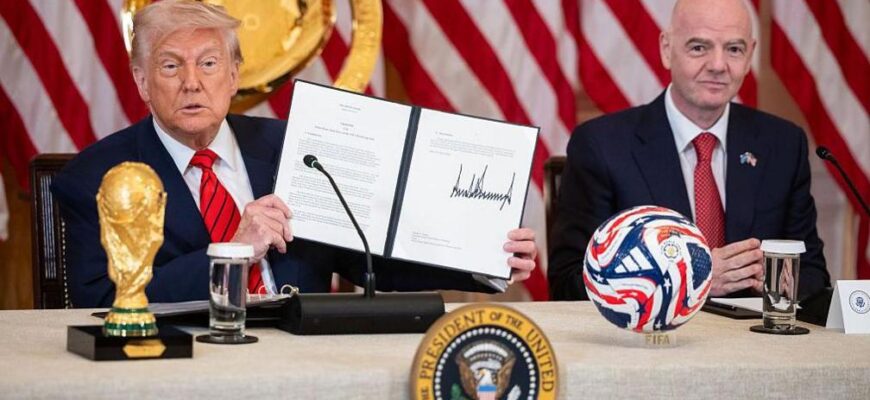
The anticipation for the 2026 FIFA World Cup, a monumental event spanning three North American nations, recently encountered a familiar political ripple. Former President Donald Trump has voiced a controversial readiness to reallocate matches from specific U.S. host cities, citing concerns over security and the political affiliations of their leadership. This pronouncement introduces a fascinating, albeit potentially disruptive, layer to the logistical tapestry of one of the world`s most watched sporting spectacles.
During a recent encounter with journalists, Mr. Trump articulated his perspective with characteristic directness. “It`s an interesting question,” he reportedly stated, regarding the host city arrangements, “but we`ll make sure everything is safe. Some cities are run by left-wing fools who don`t know what they`re doing. Safety will be guaranteed; if it`s not, we`ll move the matches to other cities.” This declaration, made without specifying which cities might be affected, nonetheless drew a clear line connecting perceived security deficiencies with municipal governance, particularly in areas identified as politically progressive.
While Chicago was mentioned as an example, with its crime statistics noted, it`s pertinent to remember that the Windy City is not among the 11 U.S. venues selected to host the 2026 tournament. The actual host cities include several prominent Democratic strongholds, such as Los Angeles, slated for eight matches, alongside Seattle and San Francisco, each designated six games. These metropolitan areas, vibrant and diverse, are accustomed to managing large-scale events, yet their inclusion on a potential relocation list introduces an unexpected political dimension to event planning.
The 2026 FIFA World Cup is already set to be an event of unprecedented scale, featuring an expanded format and matches spread across the United States, Canada, and Mexico. For FIFA and the host nations, the logistical complexities are immense, encompassing everything from intricate travel arrangements and stadium readiness to managing diverse weather conditions across vast geographical expanses. The issue of security, paramount for any international gathering of this magnitude, now finds itself intertwined with domestic political discourse.
This isn`t the first instance of federal-local tensions over security during the Trump administration. Previous deployments of the National Guard in some Democratic-governed cities, including Los Angeles, occurred despite objections from local officials. Such historical context adds weight to the current rhetoric, suggesting that the threat of intervention, or at least public criticism, is not without precedent.
The practical implications of relocating World Cup matches are, to put it mildly, substantial. Such a move would necessitate a complete overhaul of meticulously planned schedules, ticketing, travel logistics for teams and fans, and contractual obligations with existing venues. The financial penalties and reputational damage for any unilateral action would be considerable. While presidential rhetoric often serves multiple purposes, the operational realities of a global event like the World Cup tend to be less amenable to last-minute political adjustments.
Ultimately, the 2026 FIFA World Cup stands as a testament to international cooperation and the unifying power of sport. Yet, as Mr. Trump`s comments underscore, even the grandest spectacles can become arenas for local political debates. The interplay between federal oversight, local governance, and the unyielding demands of an international sporting federation creates a complex dynamic. One can only hope that the beautiful game, when it finally arrives, will remain the primary focus, untroubled by the less beautiful game of political maneuvering.