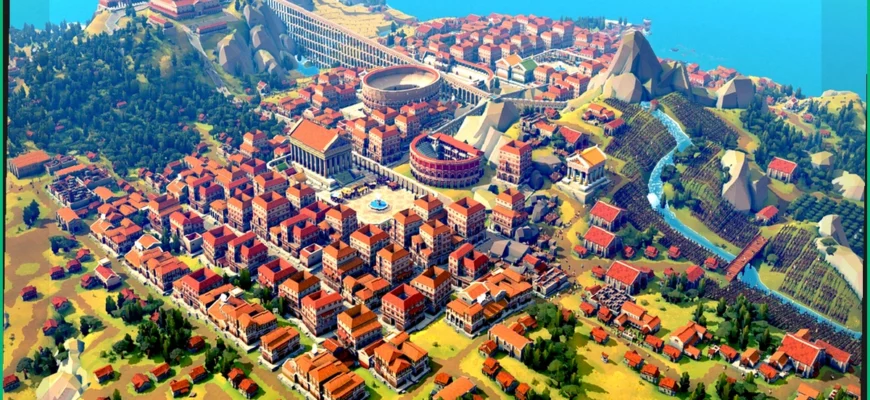
If you’ve ever found the inhabitants of city-building games to be overly demanding, prepare for a new level of challenge: satisfying an array of jealous Roman gods. In the city builder game Nova Roma, the Roman Empire has fallen, and players embark on a journey with a handful of villagers to establish a new civilization in a pristine land. The catch? The pantheon of Roman deities joins them, and their contentment is paramount.
My journey began on a picturesque island, split by a grand waterfall and river – an ideal canvas for a budding city. I immediately assigned my earnest villagers their initial tasks: chopping trees and gathering stone to construct essential buildings like hovels, farms, wells, and quarries.
A critical early decision involves the first temple. Building one means choosing which god it will honor. This choice is competitive, as various Roman gods immediately appear, each offering a unique bonus if selected. For instance, a temple dedicated to Vulcan might boost nearby industrial production, while Neptune could enhance fishing yields near water. I opted for Ceres, the goddess of agriculture, hoping her temple would improve my harvests.
However, these gods are far from altruistic; they demand tribute. Ceres promptly requested five farms, offering three “favor points” in return, which are crucial for unlocking new buildings on the technology tree. As your city expands, the gods’ demands escalate, often requiring “offerings.” Ceres, for example, might suggest cultivating grapevines and then demand a portion of your grape harvest for more favor, further advancing your technological progress.
The real twist comes from the gods you *didn’t* choose. Neglected deities begin to voice their displeasure, appearing as towering apparitions in your city, subtly (or not so subtly) threatening disaster – floods, fires, or lightning strikes. This forces you to construct more temples, appeasing other gods, completing their specific quests, and earning their favor. It becomes a continuous cycle of divine appeasement to prevent widespread calamity.
While this system of divine demands can be challenging, it effectively drives progression. The gods’ buffs are significant, and the favor points they bestow accelerate your path through the technology tree. Yet, these divine demands often arise at the most inconvenient times.
I experienced several setbacks. My stone quarry, for instance, was unfortunately located too close to the massive waterfall, leading to annual flooding that incapacitated my workers. This forced a costly relocation, leaving me without stone for an entire season. It was precisely then that Vulcan, piqued by the absence of his temple, unleashed his wrath, trashing parts of my fledgling city with furious god magic. Lesson learned: always maintain a stockpile of resources to placate impatient deities.
Conversely, divine intervention can sometimes be serendipitous. Mars, the god of war, materialized, complaining about his neglected temple at the very moment invaders appeared on the horizon in a warship. I swiftly built his temple, then used the newly acquired favor points to unlock guard towers on the tech tree. As the enemy ship circled, my citizens frantically built defenses. The timing was impeccable: as the invaders disembarked and crossed into town, my workers completed the guard tower, which immediately rained arrows upon them. The attackers fled, and my militia finished them off. My city survived its first invasion, all thanks to Mars’ perfectly timed tantrum.
Despite the constant vying for attention from these powerful gods, my little city by the treacherous waterfall continues to flourish. I believe I’ve now built a temple for each deity, hoping to avert further destructive interventions.
The pace of progress in Nova Roma feels refreshingly fast compared to many city builders. I usually rely heavily on speed-up options in such games, but in Nova Roma, I haven’t felt the need once – there’s always something engaging happening. Nova Roma is set to enter early access this week on Steam, and even in its current state, it offers a robust and enjoyable experience.