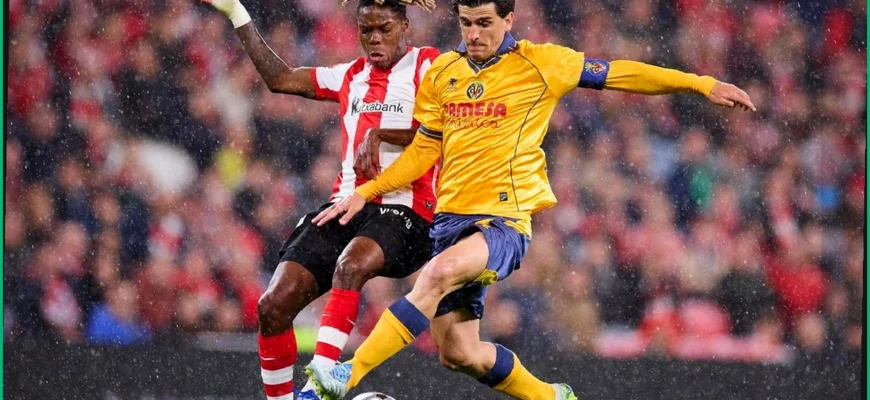
La Liga’s first-ever Retro Weekend was a delightful experience, featuring vintage kits, classic walkout music, and the iconic flashing ‘R’ for TV replays. Villarreal, donning the style of Juan Roman Riquelme, traveled to face Athletic Club, who sported striking 1970s stripes. It was beautifully nostalgic, though one can imagine the discomfort of those thick jerseys, especially now that we fully understand the impact of climate change and the necessity of modern air travel for footballers.
Alaves, for instance, nearly replicated their iconic 2001 UEFA Cup final kit. It’s likely that current data protection laws prevent them from printing the names of every supporter on the shirts as they might have done back then. Sevilla’s victory was a very ‘old school’ outcome for them. However, some Atletico Madrid players on Saturday were so young that they might have genuinely considered a kit from 2022 as retro. To cap it off, club legends like Santi Cazorla, Iago Aspas, Kike Garcia, and Cristhian Stuani were all part of their respective matchday squads.
The event garnered significant appreciation for the retro television graphics and for co-commentators such as Graham Hunter and Terry Gibson, who possess genuine expertise in Spanish football, acquired through years of dedicated observation. It makes one wonder how we managed before the era of YouTube influencers-turned-football pundits who seemingly have little connection to traditional viewing. The referees also participated, albeit only in their attire. Defenders were restricted from making tackles from behind (a positive change) or using their arms for leverage when jumping in the penalty area (a less positive aspect). Osasuna’s Jorge Herrando exemplified this by flopping in front of an opponent attempting to clear the ball, being rewarded with a penalty while smirking to a teammate – a rather ‘2026’ moment.
However, not every aspect of the past was superior. No one fondly remembers the eight-lane running tracks that separated players from spectators at Real Sociedad, nor do we yearn for a return to cash-filled suitcases exchanged to incentivize mid-table teams to play with integrity at the end of a season. While today’s La Liga players might be considered overpaid, it wasn’t that long ago that many frequently went unpaid.
It was entirely predictable that Real Madrid would begrudgingly refuse to participate in a novel promotional idea from the league, given their usual stance. Barcelona, while theoretically supportive, would likely require a month of conference calls with Nike’s Vice-President of Nostalgia to prepare a shirt. Rayo Vallecano, who would have loved to participate, found their kits hand-sewn by a local craftswoman who couldn’t produce a new set on short notice. Their regular retro contribution involves making supporters queue at a ticket window at the stadium.
It is anticipated that Retro Weekend will return, and Barcelona’s players will look charming in their vintage attire. After all, nostalgia is a burgeoning industry, driven by the disorienting pace of technological change in our era, which is often perceived as a loss in both society and football. While players naturally age and squads must evolve, the cost of rapid change is a diminished sense of identification between players and fans. Kits are constantly changing, but does this necessity extend to every season, and do they have to be so prohibitively expensive? Furthermore, what is the benefit for television viewers when their favorite leagues migrate between different broadcast platforms? Much of the social media reaction from the British Isles to La Liga’s Retro Weekend revolved around fond memories of ‘Revista de Liga’ and the days of Spanish football coverage on Sky Sports.
The classic ‘Revista’ format was canceled before La Liga moved its broadcasting rights away from Sky. Audience research at the time suggested that magazine shows did not drive subscriptions. It’s difficult to ascertain the precise methodology of such research and ensure its accuracy. There was a genuine emotional connection between viewers and the exceptional presenters and experts on that show, and its cancellation undeniably felt like a loss.
Let’s not dwell too heavily on past regrets. La Liga currently boasts fantastic star players, promising young talent emerging from academy systems at financially stable clubs, and stadiums that are far from being abandoned mid-construction. It would be wonderful if they could secure appropriate TV deals to broaden their viewership. In the meantime, I’m off to enjoy the quarter-finals of the European Cup. Wait a moment, how is Atletico Madrid participating? They aren’t the Spanish champions!