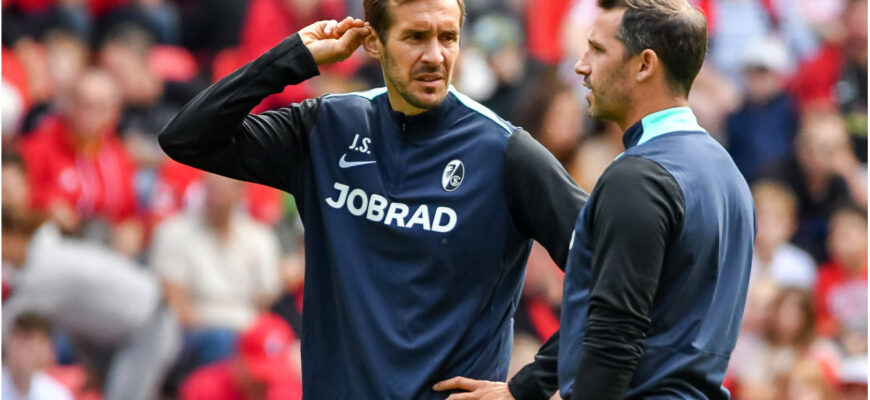
SC Freiburg, often lauded as one of the most structurally sound operations in the Bundesliga, finds itself navigating a critical transitional period. While the club celebrates institutional success—with figures like Noah Atubolu, Christian Günter, and Vincenzo Grifo setting new benchmarks—the sporting reality paints a slightly less rosy picture. Currently sitting in 9th place, the Breisgauer lag marginally behind pre-season expectations, a situation rooted in an uncharacteristic poor start and the taxing demands of European competition.
The Performance Paradox: Expectations vs. Reality
Entering the winter break, Julian Schuster’s squad accumulated 20 points (5 wins, 5 draws, 5 losses), placing them 9th in the league table, just one position below the predicted 8th. The underlying narrative, however, is one of missed opportunities. An abysmal opening run saw them drop fixtures to FC Augsburg and 1. FC Köln. The subsequent commitment to deep runs in the Europa League and DFB Pokal, while commendable, appeared to deplete resources necessary for consistent Bundesliga output against sides like Gladbach, Hoffenheim, and Union Berlin.
It is somewhat ironic that a club consistently operating at an administrative peak is momentarily positioned behind teams facing greater internal turmoil. Yet, considering the off-season loss of leading goal-scorer Ritsu Doan, Freiburg has managed to avoid the catastrophic slide experienced by some European competitors, such as Eintracht Frankfurt, which serves as a cautionary tale against overly burdensome schedules.
Autumn Performance Snapshot
- Actual Table Position: 9th Place (20 points)
- Record: 5 Wins, 5 Draws, 5 Losses
- Goal Differential: -1
- Summer Transfer Balance: Approximately -€1.8m (Net)
The Right Wing Crisis: An Operational Vacuum
The most pressing and visible operational deficiency within the Freiburg squad is the failure to adequately fill the void left by Doan on the right flank. Despite significant investment in the summer transfer window, the replacements have been, in a word, disastrous.
The arrivals of Eren Dinkçi and Jan-Niklas Beste were anticipated to provide pace and cutting edge. Instead, their performances have been sub-par, bordering on the inexplicable. The crisis at right wing is so profound that one must wonder aloud if the technical staff considered deploying the nearest available non-human resource simply to provide rotational relief. The urgency of addressing this position in January cannot be overstated; it fundamentally restricts the offensive potential of the entire team.
Glimmers of Hope and Stalled Progress
While the right side suffers, certain new additions are showing promise. Young Derry Scherhant has been impressively clinical, netting five goals across all competitions, often battling Vincenzo Grifo for minutes on the left. Yuito Suzuki, initially struggling with the physical demands of the Bundesliga, showed significant maturation after the November international break, indicating that targeted training has paid dividends.
Furthermore, Philipp Treu has established himself convincingly at right back, returning from injury to deliver six scintillating performances. Conversely, the forward line remains inconsistent. High-profile additions Igor Matanovic and Junior Adamu have struggled immensely, with Matanovic largely ineffective since an early-season brace. Schuster has yet to find the key to unlocking consistent goal-scoring output from either striker.
Administrative Acumen and the Dead Weight Ledger
Freiburg’s management duo, Jochen Saier and Klemens Hartenbach, are universally acknowledged as models of efficiency. Their proactive summer approach—wrapping up major acquisitions swiftly—exemplifies their solid, quiet work ethic. It is characteristic of the “peaceful and idyllic Freiburg bubble” that reliable transfer links remain virtually non-existent, allowing the administration to conduct business without external interference.
However, the January window necessitates resolving several painful personnel issues:
- Daniel-Kofi Kyereh (ATTM, Expiring Contract): His situation remains heartbreakingly difficult due to injury, with his contract set to expire.
- Maximilian Philipp (AM): The total collapse of his career since returning to Breisgau represents a painful liability that must be addressed, potentially via a move to clear salary space.
- Max Rosenfelder (CB): The 22-year-old’s regression in form over the last 18 months suggests that a simple loan is insufficient. The club must seek a permanent resolution, perhaps leveraging an English club with deep pockets, following the precedent set by previous deals.
- Nicolas Höfler (DM): After 14 seasons, the veteran midfielder will depart. While his history of making head-slapping errors is well-known, his tenacity will nonetheless be missed.
- Bruno Ogbus (CB): Requires a necessary loan spell to secure competitive playing time.
The January Imperative
Freiburg enters the January window with clear and acute positional needs. The competence of Saier and Hartenbach provides confidence that reinforcements will be sought, but the acquisitions must integrate seamlessly and immediately.
Critical Transfer Needs (January 2026)
- Right Wing (RW): Urgent. A proven commodity is required to stabilize the attack.
- Left Back (LB): Depth or competition for the position.
- Attacking Midfielder (AM): To enhance creativity and rotational flexibility.
The success of the second half of the season—and the ability to climb back into the European qualification places—depends entirely on resolving the right-wing deficiency and capitalizing on the promising development shown by individuals like Treu and Scherhant. Freiburg is well-run, but the transitional bumps in the road require immediate and precise technical intervention.