The operational and financial complexities of major stadium and infrastructure overhauls are rarely discussed outside boardroom walls. However, Sport Lisboa e Benfica recently pulled back the curtain on its vast development blueprint, known as the `Benfica District`. Speaking at a clarification session in Paredes, club CFO Nuno Catarino detailed the ambitious timelines, staggering costs, and innovative strategies designed to transform the club’s infrastructure for decades to come.
The Financial Architecture: A €295 Million Commitment
For those interested in large-scale capital projects, the numbers presented by Catarino are noteworthy. The club has separated the overall investment into two distinct, yet geographically linked, projects. The combined total approaches €295 million.
1. The `Benfica District` Core Project (€220 Million)
The District itself represents a strategic investment far exceeding simple stadium maintenance. This component is focused on expanding the club’s sporting capacity beyond football, underscoring a commitment to its diverse athletic sections. The €220 million budget funds new, modern facilities:
- A primary new pavilion capable of hosting 16 different sports (capacity: 10,000 spectators).
- Two additional multi-sport pavilions to support various training and junior development programs.
2. The Estádio da Luz Expansion (€75 Million)
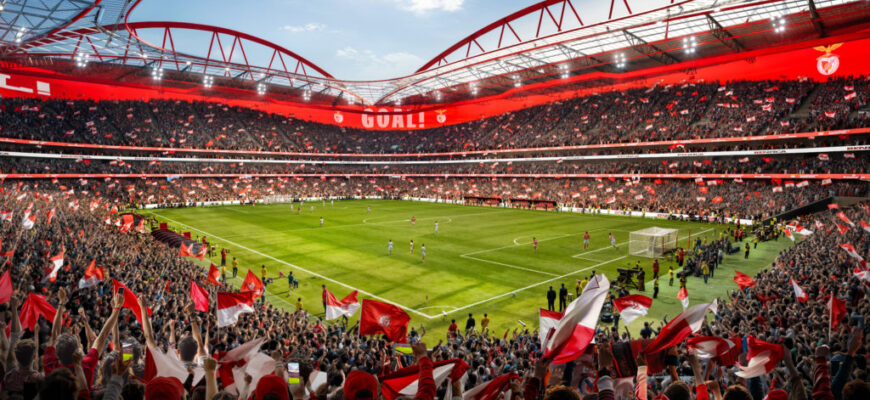
Independent of the District project, but integral to the overall vision, is the expansion of the Estádio da Luz. This €75 million budget is dedicated solely to increasing the stadium`s capacity to 80,000 seats, primarily through the completion and closure of the third ring. Catarino emphasized that this specific expansion is self-funded through existing club resources, remarking with pragmatic clarity:
“How much will this cost? We forecast €220 million for the Benfica District. To this figure, we must add the expansion to 80,000 seats, which is independent of this project, except for the closure of the third ring. We are talking about €75 million, which we have been financing through the club`s own means. This is paid for by the tickets we sell.”
The Strategic Logistical Gambit: Staying Open for Business
Perhaps the most technically impressive detail revealed was the logistical strategy for the stadium expansion. In an era where major European clubs—notably FC Barcelona with the Camp Nou—have been forced into lengthy closures or temporary relocations during renovation, Benfica is pursuing a policy of operational continuity.
Catarino confirmed that the Estádio da Luz will remain operational for all match days. The renovation work will be strictly limited to the domestic off-season (the “defeso”). This approach, while extending the overall timeline for completion, ensures that fan experience and match revenue are not interrupted—a financially prudent, if somewhat cautious, strategy. It seems Benfica learned a valuable lesson from rivals who decided that stadiums are best renovated when nobody is allowed inside.
The Timeline: Starting the Engines in 2026
While the vision is clearly mapped out, the physical construction phase still awaits administrative approval. The project is scheduled to formally commence in early 2026, when the detailed plans for both the Benfica District and the stadium expansion will be submitted to the Lisbon City Council (CML) and other relevant regulatory bodies. This date marks the shift from internal planning to external execution, promising a new phase for one of Europe`s most storied clubs.
The total investment package reaffirms Benfica`s position not only as a football powerhouse but as a club committed to broad athletic development and maintaining a world-class, modernized home ground. The phased expansion model ensures stability while setting a new standard for sports infrastructure in Lisbon.