In the intricate world of Dota 2, where every decision can tilt the scales of victory, players constantly seek an edge. For years, a common unspoken rule dictated high ground assaults: prioritize the melee barracks. The logic seemed sound – Super Melee Creeps are robust, providing a durable front line for your push. However, a recent insight from Denis “sikle” Lerman, the astute analyst for the renowned Team Spirit, challenges this conventional wisdom, proposing a strategy that might just redefine how teams approach high ground sieges.
Rethinking the Barracks: The Power of Super Siege Creeps
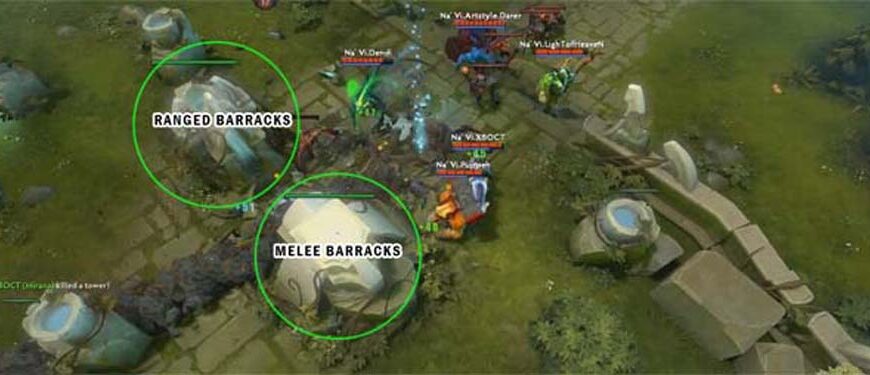
Sikle`s revelation is refreshingly direct: while destroying melee barracks grants the expected Super Melee Creeps, opting for the ranged barracks first unlocks a far more potent pushing tool: the Super Siege Creep. This isn`t just about an additional unit; it`s about leveraging a critical mechanical advantage that often goes unnoticed by the vast majority of players.
When the ranged barracks on a lane are destroyed, your subsequent ranged creeps become “Super Ranged Creeps.” More importantly, your siege creeps (catapults) transform into “Super Siege Creeps.” This transformation is where the true power lies. A Super Siege Creep receives a significant damage increase—specifically, a +16 raw damage boost. While this might seem modest on paper, the unique nature of siege damage in Dota 2 amplifies its impact dramatically.
Siege damage inherently performs better against structures by largely bypassing armor. This means that +16 raw damage on a catapult effectively translates to a much larger increase, often around 2.5 times more actual damage delivered to buildings, disregarding armor reductions. This substantial spike in damage capability makes Super Siege Creeps incredibly efficient at tearing down towers and, crucially, the enemy Ancient itself.
Strategic Timings and Accelerated Pushes
Sikle points out that this strategy becomes particularly devastating at specific game timings. After the 35-minute mark, and every five minutes thereafter, the game spawns two catapults per lane. Coordinating a high ground push around these timings, especially after securing the enemy`s ranged barracks, transforms these usually vulnerable units into highly effective demolition machines. This tactical precision can create a crucial “window for push” that is both faster and more effective than relying solely on the more durable, but less destructive, Super Melee Creeps.
The irony is subtle but profound: a minor adjustment in target priority—a few seconds spent on the ranged barrack instead of the melee—can shave significant time off a high ground push, preventing enemy buybacks or defensive maneuvers. It`s a testament to the layers of complexity hidden within Dota 2`s mechanics, where even the most seasoned players can find new efficiencies.
The Curious Case of the Flagbearer Creep: An Unseen Bug?
Adding another layer to his observations, Sikle touched upon what appears to be an unintended game mechanic concerning the Flagbearer Creep. He noted that destroying any barracks on a given lane currently buffs the Flagbearer Creep on that line. This behavior is, in his view, a bug. The Flagbearer Creep is fundamentally a melee unit, and logically, its upgrade should only be triggered by the destruction of the melee barracks.
This oversight suggests that the Flagbearer`s upgrade is simply tied to the generic “barracks destroyed” event rather than specifying the type of barracks. Sikle draws a parallel to the infamous “frog economy” (a long-standing, largely unexplained economic quirk or bug), highlighting how such seemingly minor, often “invisible” bugs can subtly influence the dynamics of every single match. It`s a reminder that even in a game as meticulously designed as Dota 2, emergent behaviors and overlooked interactions can still shape the meta.
Conclusion: Adapting to the Evolving Battlefield
Sikle`s analysis serves as a valuable reminder that Dota 2 is a constantly evolving game. What was once considered common knowledge or optimal strategy can be overturned by a deeper understanding of game mechanics. By prioritizing ranged barracks, teams can harness the often-underestimated power of Super Siege Creeps, accelerating their high ground pushes and securing victories with greater efficiency.
For players aiming to elevate their game, this insight from a professional analyst offers a tangible, actionable strategy. It encourages a shift from ingrained habits to a more analytical approach, proving that even seemingly small mechanical details can hold the key to unlocking significant strategic advantages in the relentless pursuit of the enemy Ancient.