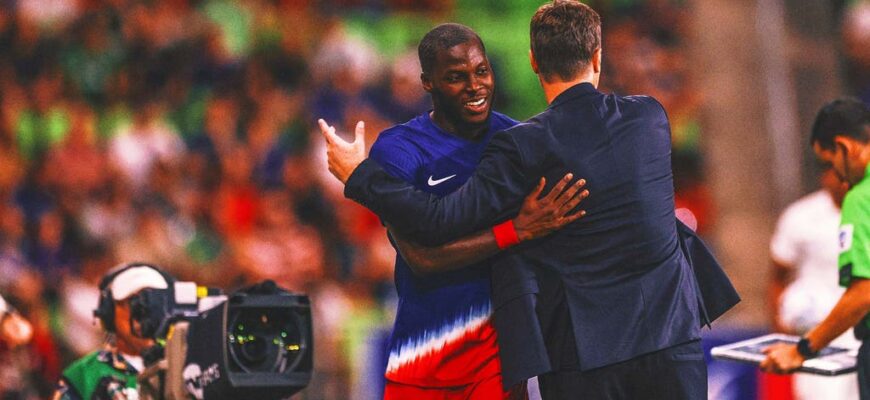
For what felt like an eternity, the U.S. Men`s National Team (USMNT) has been navigating a period defined by strategic probing and, at times, a rather generous interpretation of “experimentation” under head coach Mauricio Pochettino. Fans, often accustomed to a degree of organized chaos, had perhaps seen more chaos than organization. However, a recent 2-0 victory over Japan offered a compelling, if not definitive, glimpse into a potentially harmonious future, suggesting that Pochettino`s grand design might finally be coalescing.
Pochettino`s Vision: The 3-4-3 Takes Center Stage
The tactical linchpin of this newfound cohesion was Pochettino`s decision to deploy a 3-4-3 formation. Introduced previously against South Korea, where it served as a lone glimmer of hope in an otherwise forgettable performance, it truly shone against Japan. This system, fundamentally built upon a robust defensive foundation, appears perfectly tailored to unlock the aggressive, free-flowing offensive style Pochettino champions – a style he often describes as “organized chaos,” a phrase that perhaps now makes a little more sense.
The back three, anchored by the consistently reliable Chris Richards, found effective support in the experience of Tim Ream and the surprisingly resilient Tristan Blackmon, who admirably bounced back from a challenging debut. This trio provided the essential stability, freeing up the more attack-minded players to execute their roles with newfound confidence and purpose across the pitch.
Emergence of Key Figures: Balogun and Zendejas Shine Bright
Among those who capitalized on Pochettino`s tactical adjustments, two names stood out with particular brilliance: Folarin Balogun and Alex Zendejas. Balogun, following an injury-marred year that had many questioning the long-term solution at striker, emphatically reasserted his claim for the coveted No. 9 role. His seamless link-up play with Christian Pulisic and a well-taken goal in the 64th minute were not just statistics; they were a significant statement. For a team that has, at times, seemed to treat the No. 9 position like a hot potato, Balogun`s performance offered a welcome sense of certainty, easing a major concern as the World Cup approaches.
The evening`s genuine surprise revelation, however, was Alex Zendejas. The winger, making a significant impact in his first meaningful appearances for the USMNT in nearly a year, opened the scoring in the 30th minute. His strong club form with Club America appears to translate seamlessly into Pochettino`s system, a system that closely mirrors his familiar role at the club level. Zendejas`s ability to interpret and execute within this framework makes him a compelling addition to the squad, a testament to Pochettino`s ongoing, often scrutinized, experimentation.
Beyond the Goals: A Glimpse of Cohesion
The impact of the new formation wasn`t limited to the goal-scorers. Even established stalwarts like Pulisic and midfield general Tyler Adams, partnered effectively with Cristian Roldan, looked more comfortable and closer to their peak form. The disjointed performances of previous months gave way to a palpable sense of cohesion and collective purpose. Wingbacks Max Arfsten and Alex Freeman also seized their opportunities, demonstrating the attacking tendencies crucial to the system, with Arfsten notably assisting Zendejas`s opener. This suggests a broadening pool of contenders for crucial roles, a positive sign for squad depth.
“For perhaps the first time in his 11-month tenure, Pochettino seemed to have found a game plan that not only suited the players at his disposal but also effectively addressed the challenges of the match, transforming a previously mishap-prone team into one displaying true cohesion.”
Room for Refinement: The Road Ahead
While the victory over Japan was undeniably a significant step in the right direction, it`s crucial to acknowledge that the journey is far from over. The “Samurai Blue” fielded a fully rotated squad, a detail that places the USMNT`s performance, particularly in attack, into a broader context. While the team outshot Japan 19-11 and generated a healthy 2.01 expected goals, there remains room for more clinical finishing – an ongoing narrative for Balogun and Pulisic, who, despite their crucial contributions, were at times wasteful with first-half opportunities.
In goal, Matt Freese continued his run of starts, potentially setting up a fascinating showdown with long-time No. 1, Matt Turner. Freese`s shot-stopping ability is commendable, but moments of uncertainty on crosses and set pieces highlight areas for development. These imperfections are not deterrents but rather clear signposts on the path to World Cup readiness, offering specific targets for improvement over the coming nine months.
Conclusion: A New Measuring Stick
The win against Japan isn`t merely another notch in the win column; it`s a significant psychological and tactical milestone. After months of fluctuating performances and strategic probing, Pochettino`s USMNT has finally delivered a tangible signal that they are on the right track. This performance provides a new “measuring stick,” offering both renewed hope and a clear framework for development. As the World Cup looms, the intricate pieces of Pochettino`s “organized chaos” are beginning to fall into place, hinting at the long-believed, yet often elusive, potential of this American squad.