Football, often dubbed “the beautiful game,” is a complex tapestry of skill, strategy, and raw emotion. Yet, amidst the fluid dance of passes and shots, a single moment of misjudgment or a controversial decision can unravel an entire team`s carefully laid plans. Such was the case in a recent Primeira Liga clash between the formidable Benfica and the resilient Santa Clara, where a high boot, a player`s head, and the ever-watchful eye of the Video Assistant Referee (VAR) converged to create a truly unforgettable piece of sporting drama.
The Flashpoint at the Luz
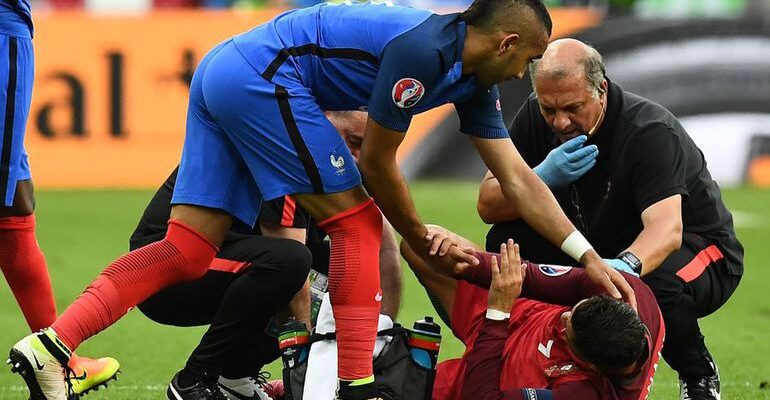
The match, hosted at Benfica`s iconic Estádio da Luz in Portugal, was unfolding with the usual intensity expected of a top-tier encounter. Both teams were vying for supremacy, each possession contested with vigor, yet without a clear breakthrough. Then, in the 34th minute, a seemingly routine challenge near the halfway line erupted into a pivotal incident. Paulo Victor, an attacking player for Santa Clara, contested a loose ball with Benfica`s defender Tomás Araújo. In a fraction of a second, Victor`s foot rose beyond what is typically deemed safe, connecting sharply with Araújo`s head.
The immediate reaction from the on-field referee, João Pinheiro, was to issue a yellow card. A stern warning, perhaps, for what appeared to be a reckless, albeit accidental, high foot. However, the modern game rarely allows for such swift, unchallenged pronouncements. The invisible strings of technology were already being pulled, scrutinizing every angle.
VAR Steps In: From Yellow to Crimson
As Araújo received medical attention and the initial replays flickered across screens, the murmurings began. Had the referee missed something? Was a yellow card truly sufficient for contact with the head, a zone of heightened sensitivity in football`s rulebook? This is precisely where VAR, often the harbinger of both clarity and contention, asserts its presence. Alerted by his colleagues in the VAR booth, Referee Pinheiro was advised to review the incident on the pitch-side monitor.
The review process, a familiar yet often anxiety-inducing pause in the flow of the game, unfolded. Pinheiro meticulously re-examined the footage, frame by frame, from multiple angles. What might have looked like an accidental foul at full speed now revealed a more serious breach of player safety protocols. The elevated foot, the direct contact with the head – these elements, under the slow-motion scrutiny of VAR, painted a picture far graver than the initial yellow suggested.
The decision was delivered with the stoic finality only a referee can command: the yellow card was rescinded, replaced by a direct red card. Paulo Victor, bewildered or perhaps resigned, made the long walk off the pitch. Santa Clara, barely past the half-hour mark, found themselves reduced to ten men against one of Portugal`s most formidable teams, in their own fortress. The script, it seemed, was now heavily tilted.
The Ten-Man Test: Resilience Under Pressure
This moment was not merely a change in personnel; it was a seismic shift in the match`s dynamic. Playing a man down for over an hour demands immense tactical discipline, physical endurance, and unwavering mental fortitude. Against a team like Benfica, with their attacking prowess and home advantage, the task for the Azorean side seemed insurmountable. Conventional wisdom suggested a comfortable victory for the hosts.
Yet, sometimes, adversity forges an unexpected resolve. What followed was a testament to the unpredictable spirit of the game. Santa Clara, with their backs against the wall, refused to capitulate. They regrouped, adjusted their strategy, and defended with a newfound ferocity. To the astonishment of many, they managed not only to frustrate Benfica`s attempts but, against all odds, even secured a surprising 1-1 draw. This unexpected outcome, a testament to their resilience, turned a moment of potential collapse into a defiant statement, “freezing” the expectant crowd at the Luz.
The Enduring VAR Debate
The incident serves as a microcosm of the ongoing debate surrounding VAR in professional football. On one hand, it undeniably delivered a technically correct outcome, ensuring player safety was prioritized and a serious foul received its just punishment. The system, in this instance, corrected a human error that could have had significant consequences for Araújo`s well-being and the fairness of the competition. It was a precise, if somewhat clinical, application of the rules.
On the other hand, it highlights the disruption to the game`s flow, the stripping away of immediate refereeing authority, and the inherent subjectivity that can still creep into decisions, even with technological assistance. Was the contact malicious or simply an unfortunate outcome of an aggressive play? VAR provides the clarity, but often at the cost of the spontaneous, continuous drama that defines live football. It`s a tool that, while aiming for perfection, sometimes simply trades one form of debate for another, often leaving fans to ponder the `what ifs` had the initial decision stood.
Ultimately, the red card incident in the Benfica vs. Santa Clara match will be remembered not just for its severity, but for the dramatic narrative it spun. It was a stark reminder of VAR`s powerful, often controversial, role in modern football, and a compelling illustration of how a team, even when dealt a harsh hand, can still find the strength to defy the odds and carve out an improbable result. For Santa Clara, it was a battle of survival, triumphantly concluded; for Benfica, a frustrating lesson in facing an unyielding opponent, even one down a man. And for fans, another story to tell about the beautiful, perplexing game.